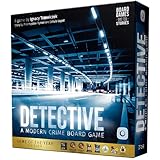
- Top Pick: Portal Games Detective , Blue
- Best Value: Cryptic Killers Unsolved Murder Mystery Game – Cold Case File Investigation – Detective Clues/Evidence – Solve the Crime – for Individuals, Date Nights & Party Groups – Murder of a Millionaire
- Premium Choice: Asmodee Sherlock Holmes Consulting Detective – The Thames Murders & Other Cases Board Game – Captivating Mystery Game for Kids & Adults, Ages 14+, 1-8 Players, 90 Min Playtime
The best detective puzzle video games do something almost no other genre attempts: they refuse to solve themselves. Instead of highlighting the clue and telling you what it means, they hand you a pile of contradictory evidence and wait for you to work it out — and the moment the answer clicks is unlike anything else in gaming.
As an Amazon Associate I earn from qualifying purchases.
This guide covers the essential detective puzzle games, what separates a genuine deduction game from a scripted mystery, and where to start depending on how much hand-holding you want. Here are eight of the finest examples the genre has produced.
| Game | Platform | Genre | Why It’s Great | Rating |
|---|---|---|---|---|
| Return of the Obra Dinn | PC, PS4, Xbox, Switch | Deduction mystery | Identify 60 fates aboard a ghost ship with no hints whatsoever | 9.5/10 |
| The Case of the Golden Idol | PC, consoles, mobile | Deduction puzzle | Frozen crime scenes you decode word by word | 9.0/10 |
| Her Story | PC, mobile | Search-based mystery | A police archive you interrogate using a text search box | 8.8/10 |
| Disco Elysium: The Final Cut | PC, PS5, Xbox, Switch | Detective RPG | The finest writing in any video game investigation | 9.6/10 |
| Phoenix Wright: Ace Attorney Trilogy | PC, PS4, Xbox, Switch | Courtroom visual novel | Cross-examination as a puzzle mechanic, endlessly imitated | 9.0/10 |
| Paradise Killer | PC, PS5, Xbox, Switch | Open-world mystery | You gather evidence freely and then decide who to accuse | 8.5/10 |
| Pentiment | PC, Xbox, PS5, Switch | Narrative mystery | 16th-century murder investigation drawn as an illuminated manuscript | 8.7/10 |
| The Roottrees are Dead | PC | Research puzzle | Reconstruct a family tree using a fake 1990s internet | 9.0/10 |
🛒 Best Price Today on Amazon
Prime members get fast, free shipping on everything above, plus member-only deals. New members get a 30-day free trial — cancel anytime.
What Makes the Best Detective Puzzle Video Games Work
The dividing line in this genre is whether the game verifies your reasoning or does it for you. In a scripted mystery, you press forward and the detective announces the deduction. In a true detective puzzle game, you enter the conclusion yourself, and the game only confirms it when you are actually right.
Return of the Obra Dinn is the purest example. It asks you to name every one of the ship’s sixty crew members and explain how each one died, and it validates your answers three at a time so you cannot brute-force it. Nothing is highlighted, no clue is flagged, and the solution lives entirely in your notes.
Deduction games: the hardest and most rewarding tier
If you want the genre at full strength, start here. Obra Dinn and The Case of the Golden Idol both refuse to guide you. The Golden Idol series presents static tableaux — a body, some documents, several bystanders — and asks you to fill in names, motives and the sequence of events by dragging words into blanks. Its sequel, The Rise of the Golden Idol, moves the formula to the 1970s and expands the scale.
The Roottrees are Dead belongs in this tier too, giving you a simulated 1990s search engine and a family tree to reconstruct from photographs, obituaries and magazine scans. All three demand that you keep external notes, and long note-taking sessions are exactly when a comfortable setup matters — a gaming chair buying guide is more relevant to this genre than to most.
Archive and footage games: investigation as research
Her Story invented this format. You have a police database of video clips and a text search field, and typing a word shows you every clip in which it was spoken. The mystery unfolds according to which words you think to try, which means two players can experience the story in completely different orders. Sam Barlow’s later Immortality applies the same idea to three lost films.
These games are quiet, dialogue-driven and heavily dependent on catching a mumbled word, so audio quality genuinely affects whether you solve them. A gaming headset buying guide is worth reading before you start one.
Courtroom and cross-examination puzzles
The Ace Attorney series turns investigation into a two-part loop: gather evidence at the scene, then find the contradiction between a witness’s testimony and the file in your court record. The remastered trilogy collects the original three games and remains the best entry point. The Great Ace Attorney Chronicles adds a joint-reasoning mechanic and a Victorian London setting.
Danganronpa: Trigger Happy Havoc takes the same structure somewhere far darker, with class trials where you shoot down lies mid-argument. It is tonally extreme, but the deduction underneath is solid.
Detective RPGs and open investigations
Disco Elysium is the genre’s high-water mark for writing. You play an amnesiac detective whose internal voices are literal skill checks, and the murder at the centre of the story is genuinely solvable — but the game is equally interested in why you became the person investigating it. Paradise Killer takes the opposite approach: an open island, free-form evidence collection, and a trial where you can accuse anyone you have built a case against, correctly or not.
Both are text-heavy, and reading thousands of words of dialogue comfortably comes down to display quality. Any good gaming monitor buying guide covers the panel and resolution trade-offs that make long reading sessions easier.
Cosy and short-form detective puzzles
Not every mystery has to be gruelling. Tangle Tower is a bright, hand-animated whodunnit with excellent voice acting and gentle logic puzzles. The Duck Detective: The Secret Salami is a two-hour comedy deduction game built around filling in blanks in your notes. Strange Horticulture asks you to identify plants from customer descriptions, which is detective work in everything but name. Frog Detective is played almost entirely for jokes.
These are ideal on a handheld or laptop, and a gaming laptop buying guide is a sensible read if you want to play them away from a desk.
Simulation-driven detective games
A newer strand generates its mysteries procedurally. Shadows of Doubt builds an entire simulated city where every resident has a home, a job and a routine, then commits a murder inside it and lets you investigate using fingerprints, security footage and door-to-door legwork. It is buggier and rougher than the handcrafted games, but no scripted mystery can match the feeling of following a lead nobody wrote for you.
Simulation of that scale hits the CPU harder than the GPU, which is one of the points a gaming PC build guide tends to make about choosing parts for the games you actually play.
How to actually play these games well
Three habits transform this genre. Keep real notes — paper or a text file, not your memory. Resist looking anything up, because a spoiled deduction cannot be un-spoiled and the payoff is the entire product. And when you are stuck, re-read what you already have rather than hunting for new evidence; in almost every well-designed detective puzzle, the answer is already sitting in your notebook. A comfortable typing surface helps if you take notes digitally, which is covered in any mechanical keyboard buying guide.
Frequently Asked Questions About Detective Puzzle Video Games
Which detective puzzle game should a complete beginner start with?
Start with The Case of the Golden Idol or Tangle Tower. Both teach deduction gradually with self-contained cases and clear feedback, so you learn the genre’s habits without the intimidating scale of something like Return of the Obra Dinn, which expects you to track sixty characters at once.
Are detective puzzle games replayable?
Mostly not, and that is the trade-off of the genre. Once you know the solution you cannot rediscover it. The exceptions are simulation-driven games such as Shadows of Doubt, which generates a new city and a new crime each time, and search-based games like Her Story, where a second run reveals clips you never found.
Do I need to take notes to finish these games?
For the harder deduction games, yes. Return of the Obra Dinn, The Roottrees are Dead and the Golden Idol games all assume you are recording names, times and relationships externally. Some games provide in-built notebooks, but even then a separate list of your own suspicions is genuinely useful.
What is the difference between a detective game and a point-and-click adventure?
Point-and-click adventures are usually built around inventory and environmental puzzles, where progress comes from finding the right object. Detective puzzle games make reasoning itself the mechanic — you input a conclusion about who, how or why, and the game checks whether your logic is sound.
As an Amazon Associate we earn from qualifying purchases at no extra cost to you.