🛒 Best Price Today on Amazon
Prime members get fast, free shipping on everything above, plus member-only deals. New members get a 30-day free trial — cancel anytime.
Best budget audiophile audio setup for gaming starts with the headphones, then adds only the amplification your model actually benefits from. For a PC desk, the practical path is a wired headphone, clean USB DAC/amp when needed, and a separate microphone if chat matters. This avoids paying for gaming features you may not use.
How to Choose a Budget Audiophile Gaming Setup
Start with the room, headphone load, connection path, and communication needs. Open-back models can sound spacious but leak audio and admit room noise; closed-back models contain more sound. Impedance also matters: a 120-ohm headphone can benefit from amplification, while a 32-ohm model may run directly from a PC.
Open-Back Soundstage
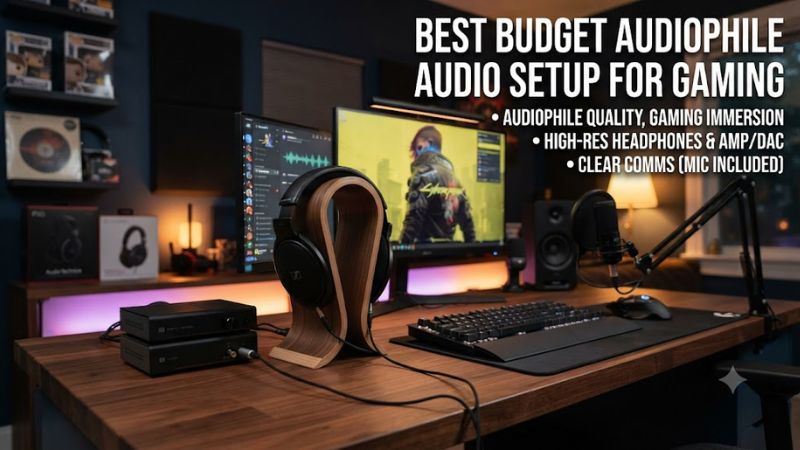
A best budget audiophile audio setup for gaming can use open-back headphones in a quiet room. RTINGS describes the HD 560S as comfortable, flat-sounding, and strong for stereo imaging, while HIFIMAN positions the HE400se as an open-back planar model. Both need a separate mic for clear voice chat needs.
The trade-off is practical: open backs leak audio and provide little isolation. That makes the HD 560S or HE400se a poor fit beside other people or a noisy PC room, even when their spatial presentation suits games. A quiet, private desk is the main requirement for this style of setup.
Closed-Back Isolation
A closed-back option makes more sense when you need less leakage or want a more contained presentation. The AKG K361 is a current model with a 32-ohm rated impedance, 50mm drivers, detachable cables, and a closed-back enclosure. RTINGS also reports acceptable wired gaming performance, with clear mids and usable left-right direction cues.
The K361 does not include a microphone, so a separate USB mic remains part of the PC gaming setup. Its passive isolation is also limited, according to RTINGS, and fit can change the bass response. That makes it easier to drive than a higher-impedance headphone, but not automatically better for every room or listener.
Amplifier and DAC Matching
A DAC converts the PC’s digital signal, while the headphone amplifier provides the electrical drive for the headphones. The important buying question is whether your headphone actually needs more output. Sennheiser says the 120-ohm HD 560S does not require an amp, although amplification can help, while the 32-ohm AKG K361 can be driven directly by PCs and consoles.
FiiO’s K11 is a useful desktop match when you want one box for demanding headphones and future upgrades. Its USB, optical, and coaxial inputs suit a PC desk, while its single-ended and balanced outputs cover common connections. Windows 10 and later can use USB DAC mode without a driver; it also supports PS5 and Switch.
PC Compatibility and Mic
Compatibility is straightforward when the chain stays analog at the headphone end: a 3.5mm or 6.35mm connection works with a suitable PC output, while a USB DAC/amp becomes the PC audio device. The HD 560S uses 3.5mm and 6.3mm connections, and the K361 includes a 3.5mm-to-6.5mm adapter in the box too.
Treat the microphone as a separate component unless the headphone explicitly includes one. The HD 560S, HE400se, and K361 have no built-in microphone, so a USB microphone or another compatible input device is required for voice chat. This separation can improve headphone choice because you do not have to accept a bundled gaming headset’s driver, microphone, or wireless system.
Top Picks for a Budget Audiophile Gaming Setup
These four combinations cover the main desktop cases without assuming every gamer needs a DAC/amp. The table separates open and closed designs, notes headphone load, and identifies the Windows PC path. Prices are omitted because street pricing changes by retailer and region; specifications below come from current manufacturer pages.
Best Overall: Sennheiser HD 560S + FiiO K11
A best budget audiophile audio setup for gaming can pair the HD 560S and FiiO K11 for games and music. The headphone is an open dynamic design rated at 120 ohms, while the K11 provides USB, optical, and coaxial inputs plus 6.35mm and 4.4mm outputs. Sennheiser says amplification is optional, not mandatory.
Buy this combination if your room is quiet and you want a separate microphone. Its real weakness is the open-back design: there is substantial leakage and little isolation, and the HD 560S has no mic. Do not buy this pairing for a shared room where other people need silence.
Best Value: Audio-Technica ATH-M40x + PC Audio
A best budget audiophile audio setup for gaming can use the ATH-M40x when the PC output is clean and loud enough. Audio-Technica lists 35-ohm impedance, 98dB sensitivity, a 15Hz–24kHz response, and two detachable cables. RTINGS describes its sound as balanced and its construction as sturdy, while noting the closed design limits soundstage.
For a best budget audiophile audio setup for gaming, this combination suits buyers who want to spend more on the headphone than on electronics. Its weakness is the narrower spatial presentation compared with open-back choices, and there is no microphone or audio control. Do not add a desktop DAC/amp merely because the product is called audiophile gear; add one if the PC output has a specific noise, volume, or connection problem.
Best for Planar Audio: HIFIMAN HE400se + FiiO K11
A best budget audiophile audio setup for gaming can use the HE400se for listeners who want planar-magnetic headphones without moving into premium pricing. HIFIMAN lists 32-ohm impedance, 91dB sensitivity, and 385g weight. RTINGS describes its response as generally accurate and its open-back design as immersive, while noting that it lacks a microphone.
The K11 gives this relatively low-impedance planar headphone plenty of desktop connectivity and output headroom, but the pairing is not the smallest option. The HE400se is also heavy and leaks sound, so it suits a stationary, quiet PC desk. Do not choose it if isolation or a built-in mic is your priority.
Best for Closed-Back Gaming: AKG K361 + PC or USB DAC
The K361 is the simplest fit for gamers who need a closed-back headphone and do not want to buy a powerful amplifier. AKG lists 32-ohm impedance, 50mm drivers, 219g weight, detachable cables, and a foldable closed-back design. RTINGS says it can be driven from a PC or console without additional amplification.
Its real weakness is consistency of the seal: RTINGS reports that glasses, hair, and head shape can change the bass response. It also lacks a microphone, so voice chat still needs a separate mic. Do not choose it expecting open-back spatial presentation; choose this setup when isolation and easy drive are more important.
| Product | Best For | Key Spec | Compatibility | Watch Out For |
| Sennheiser HD 560S + FiiO K11 | Best Overall | 120Ω headphone; 1400mW balanced K11 output at 32Ω | Windows 10+ USB; PS5/Switch via K11; wired headphone | Open-back leakage; no mic |
| Audio-Technica ATH-M40x + PC Audio | Best Value | 35Ω; 98dB sensitivity | PC 3.5mm/6.35mm with suitable adapter | Smaller soundstage; no mic |
| HIFIMAN HE400se + FiiO K11 | Best For Planar Audio | 32Ω; 91dB sensitivity | Windows 10+ USB through K11; wired headphone | 385g; open-back leakage; no mic |
| AKG K361 + PC or USB DAC | Best For Closed-Back Gaming | 32Ω; 50mm drivers | PC and consoles via analog connection | Seal affects bass; no mic |
FAQ
The short answer is that a good budget audiophile gaming setup is usually a headphone-first system, not a stack of expensive electronics. Choose the headphone for your room and sound preferences, then add a DAC/amp only when its output, inputs, or controls solve a real need. A separate microphone handles chat independently.
Is an Audiophile Headphone Better Than a Gaming Headset?
For music and wired gaming, an audiophile-oriented headphone can make sense when you value a particular sound profile, stereo imaging, comfort, or replaceable cables over bundled gaming features. The HD 560S, for example, is wired, open, and microphone-free, so the rest of the desk must cover those functions.
A gaming headset can be the simpler purchase when you need a microphone, volume controls, and one integrated device. The important distinction is the features you require. For a budget audiophile audio setup for gaming, separating headphones and microphone gives more freedom to change either component later.
Do I Need a DAC Amp for Budget Gaming Headphones?
You do not automatically need a DAC/amp for budget gaming headphones because some models run directly from a PC or console. RTINGS says the AKG K361 can be driven without extra amplification, while Sennheiser says the 120-ohm HD 560S can also work without a separate desktop amplifier at all in many cases.
A desktop DAC/amp becomes easier to justify when you need more output, digital inputs, balanced connectivity, or desktop controls. The FiiO K11 provides USB, optical, and coaxial inputs plus 6.35mm and 4.4mm outputs, so its value is mainly those capabilities rather than a promise of universally better sound.
Are Open-Back Headphones Good for PC Gaming?
Open-back headphones can work very well for PC gaming in a quiet room because they allow outside air and sound to interact with the ear cups rather than sealing the listener in. RTINGS describes both the HD 560S and HE400se as open-back wired headphones with useful stereo presentation for gaming and music.
They are a poor match for shared rooms because they leak audio and provide little isolation. If your PC sits beside a partner, family member, or microphone that can pick up speaker leakage, a closed-back option such as the AKG K361 is easier to manage. That room requirement matters as much as the headphone’s sound signature.
What Is the Cheapest Sensible Upgrade Path?
The cheapest sensible path is to start with a headphone that fits your room and use the PC output if it is clean and sufficiently loud. The ATH-M40x and AKG K361 are low-impedance wired models that do not inherently require a dedicated amplifier, so the first purchase does not have to be a DAC/amp.
If you later need a desktop control hub, the FiiO K11 adds USB, optical, coaxial, 6.35mm, 4.4mm, and RCA connectivity in one chassis. That makes it a sensible second-stage purchase for a growing desk rather than a mandatory starting point. Spend first where the headphone, room, and connection need improvement.
Final Thoughts
A best budget audiophile audio setup for gaming starts by matching the headphone to the room, then adding electronics only when they solve a real need. The HD 560S suits quiet open-back listening, the HE400se adds planar drivers, while the ATH-M40x and K361 focus on easy drive, isolation, and simple PC connections.