🛒 Best Price Today on Amazon
Prime members get fast, free shipping on everything above, plus member-only deals. New members get a 30-day free trial — cancel anytime.
An artisan mouse pad review needs to account for more than glide speed: ARTISAN sells several distinct surfaces, firmness options, and sizes that change how a pad feels during competitive play. This guide examines the NINJA FX range, official specifications, current Japanese pricing, practical limitations, and who should spend extra on one.
How to Choose an ARTISAN Mouse Pad
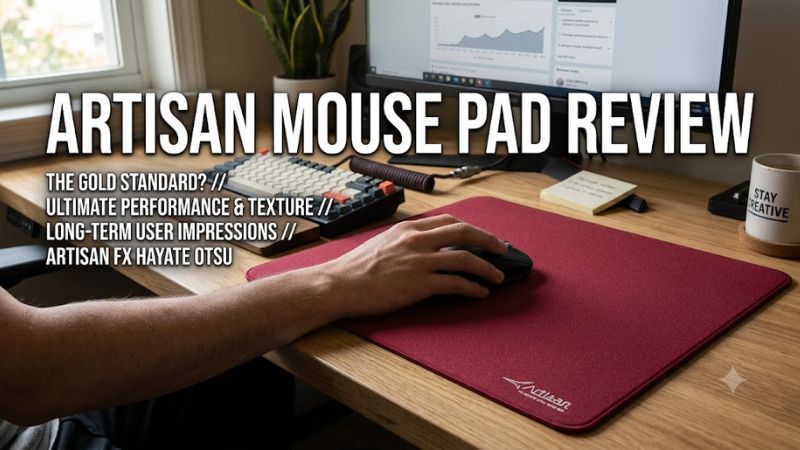
ARTISAN’s main advantage is choice rather than one universally superior surface. Its NINJA FX lineup includes balanced, control-oriented, and fast cloth pads, with different bases for different aiming preferences. Choosing the right model, size, and firmness matters more than simply buying the most expensive option.
1. Choose a surface for your aiming style
The Zero is a versatile starting point for players who want a balance of glide and stopping control. Hayate-Otsu V2 offers a faster, textured feel, while Hien has a rougher surface designed to provide stronger tactile feedback. Raiden is the speed-focused option, with a smooth surface intended for fast mouse movement. These are different preferences, not a universal performance ranking.
For tactical shooters such as Counter-Strike 2 and Valorant, players who prioritize precise stopping may prefer the Zero or a control-oriented surface. Tracking-heavy games such as Overwatch 2 may suit a faster surface, depending on sensitivity and personal preference. ARTISAN describes its speed comparisons as relative to its own products, not as standardized measurements across brands.
2. Select the right base firmness
ARTISAN offers XSOFT, SOFT, and MID bases on relevant NINJA FX models. XSOFT is the most yielding option and is intended to provide greater stopping power for micro-adjustments and recoil control. SOFT provides a middle ground, while MID is firmer and emphasizes consistent glide for tracking-oriented aiming.
The base can change how the same surface feels. Pressing the mouse into a softer pad may increase resistance, but that does not mean every player will aim better with it. If you are unsure, SOFT is ARTISAN’s recommended versatile starting point in its selection guide. Confirm that your chosen model is available with your preferred base before ordering.
3. Measure your desk before buying
ARTISAN’s NINJA FX sizes range from compact S to XXL. The listed dimensions are 240 × 210 mm for S, 310 × 240 mm for M, 420 × 330 mm for L, 490 × 420 mm for XL, and 500 × 490 mm for XXL. Most listed bases are 4 mm thick, while MID versions are 3 mm.
Low-sensitivity players who make broad arm movements should measure the available desk area and consider L, XL, or XXL. Smaller sizes may suit restricted desks or high-sensitivity play. Remember to account for keyboard placement and the mouse’s full travel, rather than measuring only the space occupied when the mouse is stationary.
4. Consider upkeep, mouse feet, and availability
A premium cloth pad still needs cleaning and sensible care. Dust, skin oils, and worn mouse feet can affect glide, while humidity and surface condition can change how a pad feels. ARTISAN also notes that surface texture and friction may vary by color variation, so do not assume every color of a model will feel identical.
Check the exact version before buying: the original Hayate-Otsu has been discontinued and replaced by Hayate-Otsu V2, while the older model may remain in limited stock. ARTISAN warns that it does not accept returns or exchanges for tracking issues or mouse compatibility. This makes choosing the right surface and checking the seller’s return policy especially important.
ARTISAN Mouse Pad Review: Specifications, Price, and Value
ARTISAN’s NINJA FX series is a premium gaming mousepad lineup, not a single product. The Zero, Hayate-Otsu V2, Hien, and Raiden serve different preferences, so value depends on the surface and base you choose. The specifications below come from ARTISAN’s published product information; subjective feel is informed by independent community reviews rather than firsthand testing by PC Gaming Universe.
ARTISAN Zero: The versatile all-rounder
The Zero uses a textured cloth surface designed to balance glide and stopping control. It suits players who want one pad for different FPS games without committing to an especially rough or extremely fast surface. Its range of firmness and size options also makes it easier to tailor the feel to an existing setup.
The trade-off is maintenance: independent reviewers have reported that the fabric can collect dust and hair. If you prefer a smoother surface or prioritize maximum speed, consider the Raiden instead. For a first premium ARTISAN purchase, however, the Zero is a sensible starting point because its intended balance is less specialized than the alternatives.
ARTISAN Hayate-Otsu V2: Balanced speed with texture
The Hayate-Otsu V2 uses a textured polyester surface designed for fast movement with controlled stopping. ARTISAN lists conductive threads intended to improve glide consistency in low-humidity environments by reducing static-related interference. This update distinguishes V2 from the original Hayate-Otsu, which has been discontinued and replaced by the newer version.
Its main appeal is the combination of speed and tactile feedback rather than maximum glide or maximum control. It is worth considering if the Zero feels too controlled but the Hien’s rougher texture sounds uncomfortable. The limitation is cost: the V2 starts at ¥7,000 on ARTISAN’s Japanese store, before any applicable shipping or import charges.
ARTISAN Hien: A rougher surface for tactile feedback
The Hien is a balanced-speed option with a distinctly rough texture. ARTISAN describes its surface as offering a fast initial glide and strong tactile feedback that helps users regulate mouse movement. Players who prefer to feel the texture under their mouse may find this more appealing than the smoother Zero or Raiden.
That texture is also its biggest drawback. Some players may find it abrasive against their skin, and preferences can change as the surface wears. The Hien is best considered by people who specifically want pronounced feedback and faster movement without choosing ARTISAN’s smoothest surface. If you favor a conventional cloth feel, the Zero is a safer alternative.
ARTISAN Raiden: The speed-focused choice
The Raiden uses a smooth, fast cloth surface made from 78% polyester and 22% polyurethane, according to ARTISAN’s specifications. The company describes it as its fastest mousepad surface. It is intended for quick, fluid movement and can appeal to players who prioritize tracking and rapid target transitions.
The limitation is that a fast surface may require an adjustment period if you are used to a control pad. Its smooth texture also provides less tactile feedback than the Hien. The Raiden is not automatically better for high-level play: choose it because you prefer a fast glide, not because a manufacturer’s speed classification promises better aim.
Comparison table: Which ARTISAN pad fits your setup?
| Product | Best For | Key Spec | Compatibility | Watch Out For |
| NINJA FX Zero | Versatile FPS gaming | Textured cloth; multiple firmness options | Standard optical gaming mice, subject to individual compatibility | Dust and hair can collect |
| NINJA FX Hayate-Otsu V2 | Balanced speed and feedback | Polyester surface with conductive threads | Check mouse tracking and preferred base | Higher starting price |
| NINJA FX Hien | Textured, faster movement | Rough cloth surface | Check comfort and mouse-foot behavior | Texture may feel abrasive |
| NINJA FX Raiden | Fast, smooth tracking | 78% polyester, 22% polyurethane | Check tracking compatibility before purchase | Less tactile feedback |
These descriptions reflect ARTISAN’s product specifications and published surface categories, supplemented by independent user reports. They are not results from a controlled head-to-head benchmark. Actual feel depends on the selected base, mouse feet, condition, and individual preference.
Price and value: Is ARTISAN worth the premium?
As of October 20, 2026, ARTISAN’s Japanese store lists starting prices of ¥3,300 for the NINJA FX Zero, ¥7,000 for the Hayate-Otsu V2, ¥3,300 for the Hien, and ¥5,000 for the Raiden. These are starting prices in Japanese yen, not verified US retail prices for a particular size, firmness, or color. Final prices may vary by configuration.
For US buyers, shipping, currency conversion, import charges, and local retailer pricing can change the total cost. ARTISAN notes that applicable customs duties and other charges may not be included in shipping fees. Compare the delivered price for your exact configuration rather than assuming the advertised starting price is the amount you will pay.
Value also depends on how much you benefit from the surface. If your current pad is comfortable and supports consistent aim, an expensive replacement is optional. If you specifically want a different glide speed, texture, or firmness, ARTISAN offers meaningful choices. The Zero is the most straightforward starting point for versatility, while the other models are better purchases when their distinctive feel matches your preference.
FAQ
1. Is an ARTISAN mouse pad worth it for gaming?
Yes, an ARTISAN pad can be worth the premium if you want a particular surface texture, glide profile, or base firmness. The benefit is customization rather than a guaranteed improvement in aim. Players satisfied with a less expensive cloth pad may not gain enough from the upgrade to justify the extra cost.
2. Which ARTISAN mousepad is best for Valorant or Counter-Strike 2?
The Zero is a sensible starting point for tactical shooters because it is designed to balance glide and stopping control. The Hien and Hayate-Otsu V2 are alternatives for players who prefer stronger texture or a faster, more responsive feel. Your sensitivity, mouse feet, and comfort should guide the final choice.
3. What size and firmness should I choose?
Choose a size that accommodates your full mouse movement, then select firmness based on how much cushioning and resistance you prefer. ARTISAN lists sizes from S through XXL, with most bases measuring 4 mm thick and MID measuring 3 mm. SOFT is the company’s versatile starting recommendation; XSOFT emphasizes a yielding feel, while MID is firmer.
4. Are ARTISAN mousepads compatible with every gaming mouse?
No, universal compatibility is not guaranteed. ARTISAN specifically warns buyers to check mouse compatibility and does not accept returns or exchanges for tracking-related issues. Before purchasing, check your mouse’s sensor behavior on the intended surface, especially if choosing a specialized pad, and review the seller’s return policy.
Final Thoughts
An artisan mouse pad review comes down to matching the surface to your preferred control, texture, and movement speed. The Zero is the sensible all-round choice, the Hayate-Otsu V2 balances speed and feedback, the Hien emphasizes rough texture, and the Raiden prioritizes smooth glide. Measure your desk and compare the delivered price before buying.