🛒 Best Price Today on Amazon
Prime members get fast, free shipping on everything above, plus member-only deals. New members get a 30-day free trial — cancel anytime.
As of September 29, 2026, the best 360mm aio liquid cooler choices span thick radiators, LCD pumps, quieter fan profiles, and software ecosystems. The right model depends on your CPU, case clearance, socket, noise target, and how much you value display or lighting features.
How to Choose a 360mm AIO Liquid Cooler
A 360mm radiator gives three 120mm fans more surface area than a 240mm design, but dimensions vary enough to affect case fit. Start with radiator thickness, total radiator-plus-fan depth, mounting position, socket support, and control requirements. These four checks narrow the field before price or appearance enters the decision.
Check radiator and case clearance
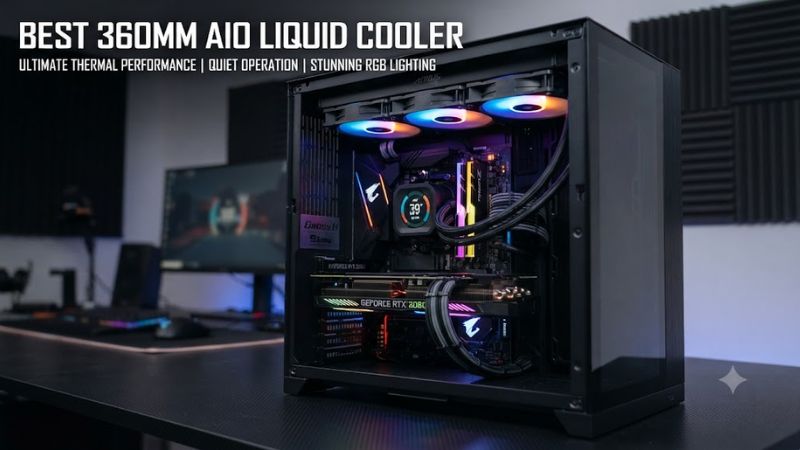
For the best 360mm aio liquid cooler fit, measure the exact mounting area rather than relying on a case label that says “360mm compatible.” Arctic’s Liquid Freezer III Pro 360 uses a 38mm radiator, while many alternatives use radiators near 27mm thick. Fan thickness adds further depth.
That difference matters when a top-mounted radiator shares space with tall motherboard heatsinks or memory. Arctic specifies at least 63mm installation clearance for the Liquid Freezer III Pro. A case can therefore accept a nominal 360mm radiator while still creating conflicts around the CPU socket or upper motherboard area.
Match the CPU socket
Socket compatibility is the second filter for a best 360mm aio liquid cooler. The current Arctic, Corsair, NZXT, and Thermalright models covered here support AM4 and AM5, while also supporting Intel LGA1700 and LGA1851. Thermalright additionally lists LGA115x, 1200, 2011, and 2066.
Memory generation is not determined by the AIO itself. DDR4 or DDR5 support comes from the motherboard and CPU platform, while radiator placement determines whether tall DIMMs or motherboard heatsinks create installation conflicts. Check the complete motherboard-and-case combination before ordering rather than treating socket support as the only compatibility test.
Compare control and cable requirements
The best 360mm aio liquid cooler for a simple build may differ from one aimed at an RGB-heavy ecosystem. Arctic uses PWM connections, while Corsair’s Titan RX RGB is designed around iCUE Link and includes digital control. NZXT’s Kraken Elite relies heavily on CAM for configuration and display control.
Power requirements also deserve attention. Corsair specifies a six-pin PCIe power connection for the Titan RX RGB system, while other models use different combinations of motherboard fan, RGB, USB, SATA, or dedicated controller connections. Confirm available headers and PSU connectors before choosing a feature-heavy AIO.
Separate cooling needs from extras
A 360mm radiator is most useful when the CPU can generate substantial sustained heat, but gaming loads vary by processor, game, frame rate, and background workload. A high-end AIO can therefore be unnecessary for a modest CPU that rarely approaches its thermal limits during normal play.
For a demanding processor, independent thermal results provide more useful context than a manufacturer’s maximum fan speed. Hardware Busters measured the Arctic Liquid Freezer III Pro on Intel Core Ultra 9 285K and Ryzen 9 7900X systems, while Tom’s Hardware has published comparable CPU-cooling measurements for several current 360mm models.
Top Picks
The four models below cover different buying priorities rather than treating one cooler as suitable for every build. Arctic emphasizes cooling hardware and a thick radiator, Thermalright adds an LCD at a lower price tier, Corsair targets iCUE users, and NZXT combines cooling with a configurable pump display.
| Product | Best For | Key Spec | Compatibility | Watch Out For |
| Arctic Liquid Freezer III Pro 360 | Best Overall | 398 × 120 × 38mm radiator; 600–3000 RPM fans | AM4/AM5; LGA1700/1851 | Thick radiator and motherboard M.2 clearance |
| Thermalright Grand Vision 360 | Best Value | 403 × 120 × 27mm; 480×480 LCD | AM4/AM5; LGA115x/1200/1700/1851/2011/2066 | Cable management is less tidy |
| Corsair iCUE Link Titan 360 RX RGB | Best For iCUE | 396 × 120 × 27mm; 300–2100 RPM | AM4/AM5; LGA1700/1851 | Higher price and PCIe power connection |
| NZXT Kraken Elite 360 RGB | Best For LCD Display | 401 × 120 × 27mm; 2.7-inch LCD | AM4/AM5; LGA1700/1851/1200/115x | Premium price and CAM dependence |
Arctic Liquid Freezer III Pro 360
For buyers prioritizing raw CPU cooling hardware, the Arctic Liquid Freezer III Pro 360 combines a 38mm radiator, three P12 Pro fans reaching 3000 RPM, a copper micro-skived cold plate, and an integrated VRM fan. Its stated socket support covers AM4, AM5, LGA1700, and LGA1851.
Hardware Busters used a Core Ultra 9 285K and Ryzen 9 7900X, 25°C ambient conditions, Prime95 small FFTs, and 20-minute runs. Resolution is not applicable to this CPU thermal benchmark. The main weakness is physical depth: Arctic specifies 63mm installation clearance and notes some M.2 heatsink conflicts.
Thermalright Grand Vision 360
The Thermalright Grand Vision 360 suits buyers who want a display without moving immediately into the highest-priced LCD AIO tier. It combines a 403mm-long, 27mm-thick radiator with a 3.4-inch 480×480 display, 28mm fans, and a pump rated up to 6400 RPM. Thermalright lists broad Intel and AMD socket support.
Tom’s Hardware measured it with an Intel Core i7-14700K and Core Ultra 9 285K. In its 38.9 dBA noise-normalized CPU-only benchmark, the cooler averaged 258W cooled with the i7-14700K; resolution is not applicable, and the source specifies its CPU and acoustic settings. The weakness is cable management around the display and fan connections.
Corsair iCUE Link Titan 360 RX RGB
The Corsair Titan 360 RX RGB is aimed at builders already using Corsair’s iCUE ecosystem. Its 396mm radiator is 27mm thick, the included RX120 fans run from 300 to 2100 RPM, and the cooler supports AM4, AM5, LGA1700, and LGA1851. Corsair also rates the cooling warranty at six years.
Tom’s Hardware used an i7-14700K and Core Ultra 9 285K for CPU thermal measurements, while AnandTech used constant thermal loads and reported 0.0703°C/W average thermal resistance at maximum fan speed. These are CPU-cooling tests, so resolution is not applicable. The main drawback is cost plus the required PCIe power connection.
NZXT Kraken Elite 360 RGB
The NZXT Kraken Elite 360 RGB is the display-focused choice, with a 401 × 120 × 27mm radiator and a 2.7-inch pump display. NZXT lists AM4, AM5, LGA1700, and LGA1851 support for the current Elite platform, while the 2024 model documentation also covers older Intel sockets.
Tom’s Hardware used an i7-14700K with a 38.9 dBA noise-normalized setting and recorded 257W cooled on average. Its gaming-oriented CPU-plus-GPU scenario used a 165W CPU load and full RX 7900 GRE GPU load; resolution is not applicable because the benchmark measures thermal load rather than rendered frames. The weakness is price and software dependence.
FAQ
Choosing a 360mm AIO involves more than radiator size because installation space, CPU power, controls, and socket support all affect the result. The current models above share mainstream AM4, AM5, LGA1700, and LGA1851 support, but their physical dimensions and connection systems differ enough to check individually.
Is a 360mm AIO worth it for gaming?
A 360mm AIO is most useful for gaming PCs with CPUs that sustain substantial heat, while a smaller cooler can be sufficient for lower-power processors. The larger radiator provides additional surface area and can allow lower fan speeds for a given thermal load, although actual gaming temperatures depend heavily on CPU power and case airflow.
The best 360mm aio liquid cooler therefore depends on the processor rather than the radiator label alone. Tom’s Hardware notes that 360mm units generally offer greater cooling potential than 240mm models, while also requiring more case space. For a CPU with modest gaming power, the extra radiator capacity may have limited practical value.
Will a 360mm AIO fit any case that supports 360mm radiators?
No, a case can list 360mm support while still having insufficient clearance for a particular radiator and fan combination. Radiator thickness, fan thickness, motherboard heatsinks, memory height, tubing direction, and mounting position all influence fit. Arctic’s 38mm radiator illustrates why checking the actual dimensions matters.
The best 360mm aio liquid cooler for a compact case may therefore be a 27mm-radiator model rather than the thickest design. Thermalright, Corsair, and NZXT use radiators around 27mm thick in the models listed here, while their overall assemblies still require room for the included fans and pump tubing.
Do 360mm AIOs work with AM5 and LGA1851?
Yes, the four models in this roundup support both AMD AM5 and Intel LGA1851, although mounting hardware and installation details vary by product. Arctic, Corsair, NZXT, and Thermalright each document these sockets for their respective current 360mm models, so compatibility should be checked against the exact SKU.
The best 360mm aio liquid cooler for an upgrade build should also be checked against the motherboard and case. RAM type such as DDR4 or DDR5 is determined by the platform, not the AIO, while radiator placement can affect access to motherboard slots, headers, and upper heatsinks during installation.
Do I need a 360mm AIO for a high-end gaming CPU?
Not automatically, because cooling requirements depend on sustained CPU power, workload, fan noise preference, case airflow, and processor limits. A 360mm AIO gives more thermal capacity than many smaller liquid coolers, but the benefit is most apparent when the CPU regularly produces enough heat to use that capacity.
For buyers comparing the best 360mm aio liquid cooler options, independent thermal measurements are more useful than a single advertised fan-speed figure. The benchmark sources here use different CPUs and methods, so their numerical results should not be combined into one universal ranking. Use each result as evidence for its stated test conditions.
Final Thoughts
The best 360mm aio liquid cooler depends on the build around it: Arctic emphasizes radiator capacity, Thermalright adds an LCD at a lower tier, Corsair integrates deeply with iCUE, and NZXT focuses on its display ecosystem. Verify case clearance, socket support, headers, and PSU connections before buying.